博文

How Should Refractory Bricks be Used for Glass Kilns?

图片
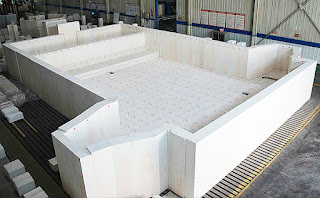
  Glass is mainly made by using silica sand and soda ash as raw materials through high-temperature melting. Glass melting furnace is thermal equipment for melting glass, usually made of refractory bricks. Glass melting furnaces can be divided into two categories: pool kilns and crucible kilns. According to the operation mode, it is divided into continuous operation furnace and intermittent operation furnace. According to the heating method, it can be divided into the flame kiln and electric heating kiln. So, how should refractory bricks be used in glass kilns? Perhaps manufacturers (  https://www.hy-refractory.com/  ) of  refractory materials for glass kilns  will answer such questions for us. Refractory Bricks Used for Glass Kiln Because refractory bricks are widely used, from low temperature to medium temperature to high temperature, it is a necessity for the construction of the lining structure of industrial kilns. When we choose refractory materials, we must...

What is the Performance and Service Life of High Chrome Bricks?

图片
Performance and application range of high chrome brick High chromium bricks are made of industrial-grade chromium oxide and alumina as the main raw materials or introduce a small amount of zirconia. After high-temperature firing, a shaped refractory product with a chromium trioxide content of not less than 75% and a combined content of chromium trioxide, alumina, and zirconia not less than 98% is obtained. It has excellent corrosion resistance, high compressive strength at room temperature, high strength at high temperature, excellent wear resistance, high refractoriness, excellent thermal shock resistance, and good volume stability at high temperatures. High Chrome Bricks High chromium bricks are divided into four grades according to the content of chromium trioxide: GGZ-75, GGZ-85, GGZ-90, GGZ-95. In the grades, G, G, Z- are the initials of the Chinese phonetic alphabet of Gao, chromium, and brick respectively, and the Arabic numerals are the mass fractions of chromium trioxide. Hig...

What are the Roles of Zirconia Refractory Raw Materials in Refractory Materials?

图片
Zircon and ZrO2 refractories made of zirconia -based refractory materials have excellent chemical resistance and high-temperature performance. For example, zirconia bricks are used for the slag line of steel drums, ZrO2 bricks are used for the nozzle holes of sliding nozzles, and ZrO2 quality sizing nozzles for horizontal continuous casting. At the same time, the zirconia -based raw materials are introduced into other refractory materials, and the phase change of ZrO2 is used to greatly improve the performance of the original materials, especially the thermal shock stability. RS High-Quality Zirconia Bricks for Sale The Effect of adding Z irconia R efractory Materials Adding ZrO2 to refractory materials mainly has the following two functions. ①The main crystalline phase or the secondary crystalline phase is generated so that the material has special properties. For example, the most well-known fused corundum brick. The composition of the #33 fused cast zirconia corundum brick produce...

Why Use Alkaline Refractory Bricks for Precalcined Cement Kilns?

图片
Why Use Alkaline Refractory Bricks for Precalcined Cement Kilns?  During the calcination process of the pre calcining kiln clinker, a large amount of melt (liquid phase) appears in the kiln material from the back end of the upper transition zone. Some ingredients in the kiln material are calcined in the melt through the raw maturation material until it is out of the kiln. Within this range, alkaline refractory bricks that withstand high temperatures can meet their process performance requirements. The masonry length of alkaline refractory bricks is about (6~10)D of the kiln diameter, which is also the most severely damaged part of the lining brick. The use of the lining brick in this part directly affects the operation rate of the kiln. Therefore, the technological progress and product performance, and output status of basic refractory bricks are paid attention to by people. At present, the alkaline refractory bricks used in the pre-calcining kiln are mainly spinel magnesia bricks...

How Much do you Know About the Production Process of Aluminum Carbon Bricks?

图片
In 1983, Japan used the non-burning Al2O3-SiC-C refractory material that can meet the needs of modern torpedo-type hot metal ladle trucks and ladle, which triggered a world revolution. Aluminum-carbon bricks belong to the range of aluminum-carbon refractory materials. The so-called aluminum-carbon refractory material refers to the carbon made by bonding alumina raw materials and carbon raw materials, in most cases, other raw materials, such as silicon carbide, metal silicon, etc., with organic binders such as pitch or resin. Composite refractory material. Broadly speaking, the refractory with Al2O3+C as the main component is called aluminum-carbon refractory. According to the production process, aluminum-carbon refractories can be divided into two categories: unburned aluminum-carbon refractories and fired aluminum-carbon refractories. The performance characteristics are strong corrosion resistance, good thermal shock stability, high strength, and high thermal conductivity. So, how mu...

Refractory Materials for Incinerators in Petrochemical Industry

图片
The petrochemical industry incinerator is an intermittent working kiln, and the lining mainly uses high alumina bricks, refractory castables, refractory plastics, etc. The working environment of the incinerator is harsh, and the inner lining is damaged by various chemical erosion, physical erosion, and mechanical stress. High-Quality High Alumina Bricks for Sale Refractory materials used in incinerators in the petrochemical industry have higher requirements than general industrial kilns. Not only must it withstand high temperatures, but it must also have excellent corrosion resistance, wear resistance, and high-temperature stability. In the petrochemical refining industry, tail liquid vertical incinerators are more common. The main operating mechanism of the incinerator is to oxidize and burn the toxic organic matter in the petrochemical tail liquid, convert it into harmless gas and then empty it. Under the normal atomization condition of the tail liquid nozzle of the incinerator, the...

Reasons for Loss of Refractory Materials for Glass Kiln Wall

图片
The glass melting furnace is the heart of the float glass production line. The service life of the glass melting furnace mainly depends on the corrosion and burning degree of the wall of the melting furnace, the dam, and the regenerator. The corrosion degree of the pool wall is the key part that affects the life of the furnace. The batch material is heated by the high-temperature radiation of solids passing through the flame along the longitudinal direction of the furnace. The first stage is the silicate reaction between various components in the raw material. The second stage is the unreacted foamy silicate ballast. The third stage gradually melts into molten glass. Na2O penetrates into the interior from the glass phase and pores of the wall tiles by means of penetration, diffusion, and substitution, and the protective layer is lost under the action of the temperature erosion of the glass liquid and the flow of the glass liquid. Alkaline oxide is the main factor causing the erosion of...